> ## Documentation Index
> Fetch the complete documentation index at: https://docs.crazygoldfish.com/llms.txt
> Use this file to discover all available pages before exploring further.
# Ecosystem Vision
> CrazyGoldFish transforms fragmented EdTech tools into one integrated AI ecosystem where evaluation, personalization, content generation, and observation reinforce each other.
Most education platforms are fragmented: separate tools for evaluation, content, analytics, and parent engagement.\
CrazyGoldFish transforms this into a **unified AI reasoning layer** where every component strengthens the others.
.png?fit=max&auto=format&n=AyrRHcU8zhmM0ddd&q=85&s=ebae9537408d5d88584d22e42aefb55e) ***
## The Problem: Fragmentation
* **Multiple vendors** → Exams, content, analytics run in silos.
* **Inefficient workflows** → Teachers spend hours moving data across tools.
* **Lost insights** → Evaluation data rarely feeds into lesson planning or remediation.
* **Low adoption** → Parents and leaders lack visibility, leading to disengagement.
***
## The Solution: Integration
CrazyGoldFish creates a **continuous ecosystem loop**:
1. **Evaluate** → Student work is assessed across formats (text, handwriting, diagrams, audio, video).
2. **Personalize** → Results generate action plans for students, teachers, and parents.
3. **Generate** → AI Studio builds lesson plans, worksheets, exams, and model answers aligned to curriculum.
4. **Observe** → ClassTrack captures classroom signals and provides feedback.
5. **Engage** → Transparent reports, activity packs, and dashboards close the loop with all stakeholders.
**Every step powers the next.** Evaluation data drives personalization → which informs content → which adapts based on classroom observation → which feeds back into evaluation.
***
## Measurable Outcomes
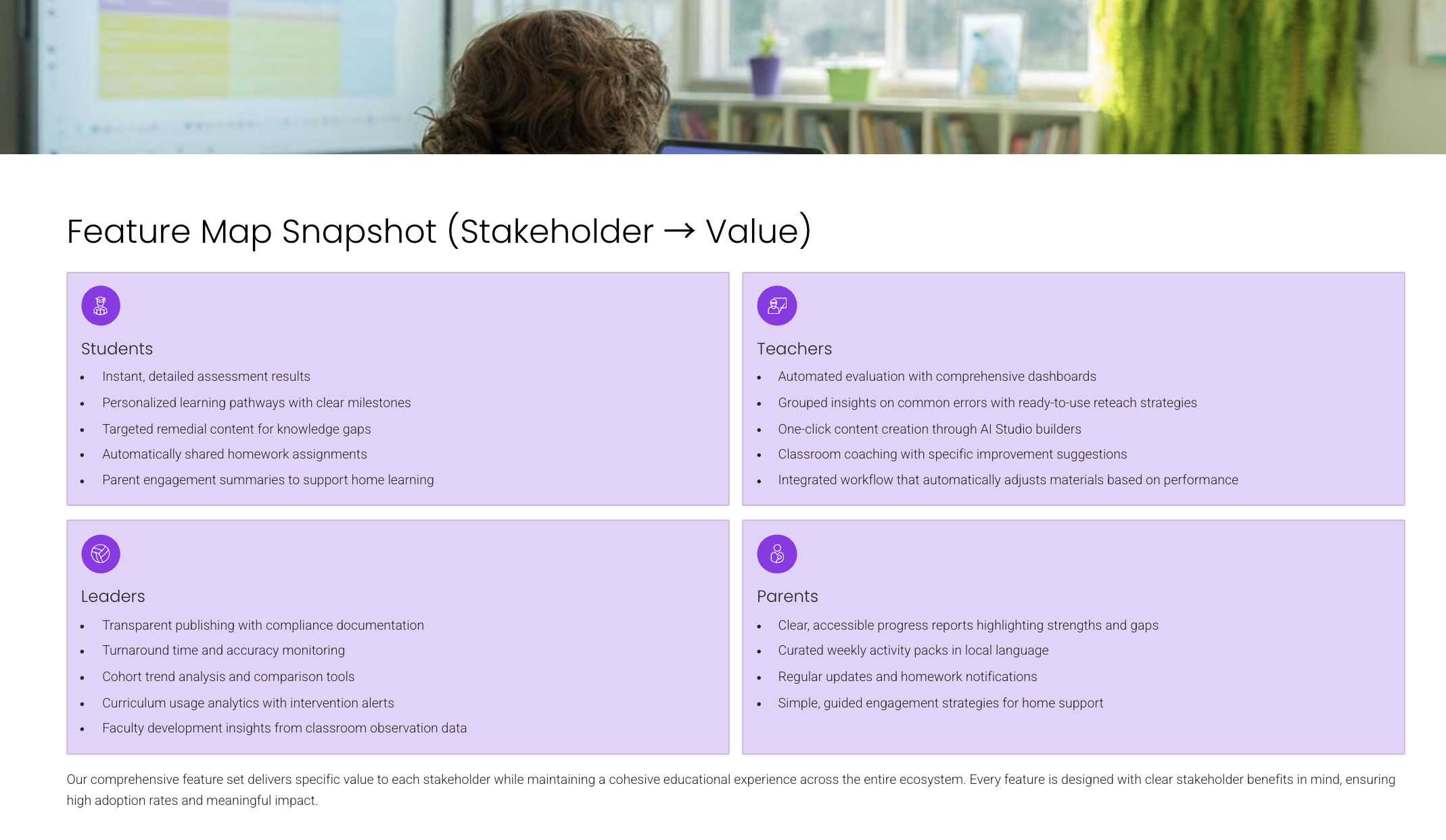
* **Students** → Clear progress pathways, targeted remediation, higher achievement.
* **Teachers** → Save 8–10 hours/week, gain insights into common errors.
* **Leaders** → Transparent dashboards, compliance-ready reporting, improved teaching quality.
* **Parents** → Weekly activity packs and simplified updates strengthen home–school connection.
***
***
## The Problem: Fragmentation
* **Multiple vendors** → Exams, content, analytics run in silos.
* **Inefficient workflows** → Teachers spend hours moving data across tools.
* **Lost insights** → Evaluation data rarely feeds into lesson planning or remediation.
* **Low adoption** → Parents and leaders lack visibility, leading to disengagement.
***
## The Solution: Integration
CrazyGoldFish creates a **continuous ecosystem loop**:
1. **Evaluate** → Student work is assessed across formats (text, handwriting, diagrams, audio, video).
2. **Personalize** → Results generate action plans for students, teachers, and parents.
3. **Generate** → AI Studio builds lesson plans, worksheets, exams, and model answers aligned to curriculum.
4. **Observe** → ClassTrack captures classroom signals and provides feedback.
5. **Engage** → Transparent reports, activity packs, and dashboards close the loop with all stakeholders.
**Every step powers the next.** Evaluation data drives personalization → which informs content → which adapts based on classroom observation → which feeds back into evaluation.
***
## Measurable Outcomes
* **Students** → Clear progress pathways, targeted remediation, higher achievement.
* **Teachers** → Save 8–10 hours/week, gain insights into common errors.
* **Leaders** → Transparent dashboards, compliance-ready reporting, improved teaching quality.
* **Parents** → Weekly activity packs and simplified updates strengthen home–school connection.
***
 ## FAQ
CrazyGoldFish replaces fragmented tools with a single AI reasoning layer so Evaluate → Personalize → Generate → Observe share data, rubrics, and context. Multimodal evaluation feeds actionable insights that trigger personalized plans and curriculum-aligned content, while observation signals inform updates—creating a continuous improvement loop rather than isolated workflows.
Evaluations and generated materials follow board and standards structures with CBSE/ICSE/GDPR aligned configurations for assessment, reporting, and data flows. You define roles, publish states, and audit logs to match institutional policies so governance remains consistent across schools while keeping data privacy-by-design.
Human-in-the-loop checkpoints allow academic leaders and teachers to review and adapt rubrics and model answers, approve results, and handle edge cases before publishing. This oversight maintains trust and helps the system target 95% accuracy while preserving transparency through auditability.
You can embed the white‑label UI for a fast launch or call the APIs to plug into existing submission and results flows—both paths are designed for a 24h integration. Configuration focuses on roles, publish states, and audit logs so you can roll out governance quickly across institutions without standing up an AI team.
The platform runs a unified pipeline for multimodal work, applying rubric- and model‑answer–based logic for consistent scoring across formats. Those structured results power personalization and content generation in the same stack, avoiding the inconsistencies that come from separate tools.
Roles control who can review, approve, and publish; publish states enforce when results become visible; and audit logs record every decision for compliance. Together, they deliver institution‑grade governance within the unified AI layer, so you can scale quality assurance and oversight without building a dedicated AI team.
APIs and the white‑label UI expose transparent, board‑aligned breakdowns that map to your rubrics and model answers, making outputs immediately consumable by downstream modules. This keeps Evaluate → Personalize → Generate tightly coupled so action plans and curriculum content are produced from the same verified signals.
By anchoring evaluation and content to board and standards structures (CBSE/ICSE aligned), the system standardizes rubrics and reporting regardless of the front‑end surface. Because all modules sit on the same reasoning layer, alignment decisions propagate consistently to personalization, content, and observation.
Observation sits on the same AI reasoning layer, so signals from classrooms inform rubric calibration and content updates. This feedback ensures evaluation criteria and generated materials evolve with real usage, reinforcing the loop rather than operating as a separate analytics tool.
You deploy managed building blocks—APIs and a white‑label UI—configure roles, publish states, and audit logs, and operate within CBSE/ICSE/GDPR aligned defaults. Day‑to‑day reliability comes from human‑in‑the‑loop checkpoints and standardized workflows in the unified stack, not from an internal data science or MLOps function.
## FAQ
CrazyGoldFish replaces fragmented tools with a single AI reasoning layer so Evaluate → Personalize → Generate → Observe share data, rubrics, and context. Multimodal evaluation feeds actionable insights that trigger personalized plans and curriculum-aligned content, while observation signals inform updates—creating a continuous improvement loop rather than isolated workflows.
Evaluations and generated materials follow board and standards structures with CBSE/ICSE/GDPR aligned configurations for assessment, reporting, and data flows. You define roles, publish states, and audit logs to match institutional policies so governance remains consistent across schools while keeping data privacy-by-design.
Human-in-the-loop checkpoints allow academic leaders and teachers to review and adapt rubrics and model answers, approve results, and handle edge cases before publishing. This oversight maintains trust and helps the system target 95% accuracy while preserving transparency through auditability.
You can embed the white‑label UI for a fast launch or call the APIs to plug into existing submission and results flows—both paths are designed for a 24h integration. Configuration focuses on roles, publish states, and audit logs so you can roll out governance quickly across institutions without standing up an AI team.
The platform runs a unified pipeline for multimodal work, applying rubric- and model‑answer–based logic for consistent scoring across formats. Those structured results power personalization and content generation in the same stack, avoiding the inconsistencies that come from separate tools.
Roles control who can review, approve, and publish; publish states enforce when results become visible; and audit logs record every decision for compliance. Together, they deliver institution‑grade governance within the unified AI layer, so you can scale quality assurance and oversight without building a dedicated AI team.
APIs and the white‑label UI expose transparent, board‑aligned breakdowns that map to your rubrics and model answers, making outputs immediately consumable by downstream modules. This keeps Evaluate → Personalize → Generate tightly coupled so action plans and curriculum content are produced from the same verified signals.
By anchoring evaluation and content to board and standards structures (CBSE/ICSE aligned), the system standardizes rubrics and reporting regardless of the front‑end surface. Because all modules sit on the same reasoning layer, alignment decisions propagate consistently to personalization, content, and observation.
Observation sits on the same AI reasoning layer, so signals from classrooms inform rubric calibration and content updates. This feedback ensures evaluation criteria and generated materials evolve with real usage, reinforcing the loop rather than operating as a separate analytics tool.
You deploy managed building blocks—APIs and a white‑label UI—configure roles, publish states, and audit logs, and operate within CBSE/ICSE/GDPR aligned defaults. Day‑to‑day reliability comes from human‑in‑the‑loop checkpoints and standardized workflows in the unified stack, not from an internal data science or MLOps function.