> ## Documentation Index
> Fetch the complete documentation index at: https://docs.crazygoldfish.com/llms.txt
> Use this file to discover all available pages before exploring further.
# Introduction
> CrazyGoldFish is the complete AI reasoning layer for education, unifying evaluation, personalization, content generation, and observation into one integrated AI stack. Transform your educational platform with AI-powered assessment, personalized learning, and intelligent content generation.
CrazyGoldFish unifies fragmented tools — **evaluation, personalization, content generation, and observation** — into one **AI reasoning layer** that drives measurable outcomes for students, teachers, leaders, and parents.
## The AI Reasoning Layer for Ed tech players
Education platforms today are fragmented: one system for grading, another for content, another for analytics. This creates **inefficiency, data silos, and missed learning opportunities**.
CrazyGoldFish replaces scattered point solutions with an **integrated AI stack** that continuously improves outcomes.
 > Our integrated AI system creates a continuous feedback loop where each component enhances the others. Evaluation data drives personalization, which informs content generation, while classroom observations provide real-time insights that loop back to adjust plans and materials. The entire system works together to create a comprehensive educational experience with parents fully integrated into the learning journey.
**This interconnected approach ensures that insights from one area automatically enhance all others, creating an intelligent educational ecosystem that continuously improves over time.**
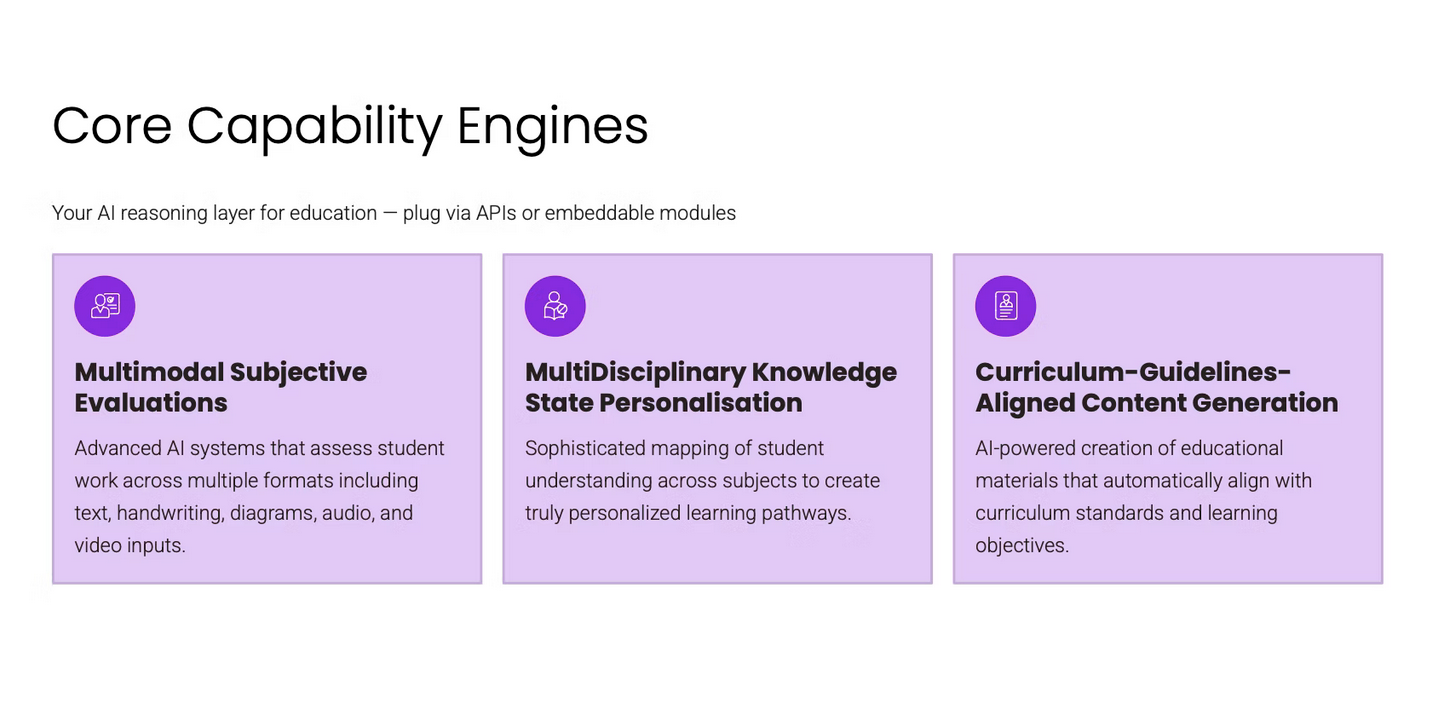
* **Evaluate** → Automate multi modal subjective assessment across exams and assignments.
* **Personalize** → Convert evaluation data into actionable plans for students, teachers, and parents.
* **Generate** → Instantly create lesson plans, worksheets, exams, and model answers aligned to curriculum standards.
* **Observe** → Capture classroom insights and teaching effectiveness to adjust strategies.
* **Engage** → Deliver transparent reports, activity packs, and home–school connection tools.
***
## Next Steps
* Learn how evaluation works in the [Evaluation Layer →](/products/evaluation-layer-overview)
* Or start building right away with [Quickstart →](/home/authentication-process)
* Integrate via REST APIs: see the [API Reference](/api-reference/endpoint/authentication) for authentication and all endpoints (exam evaluation, assignments, lesson plans, rubrics, webhooks, and more).
## FAQ
The platform converts scores and feedback from multimodal assessments into role-specific Action Plans for students, teachers, and parents. These plans drive reteach strategies and content generation, and can be accessed or distributed via APIs, webhooks, and LMS/ERP connections.
CrazyGoldFish evaluates text, handwriting, diagrams, audio, and video in a single stack. It targets \~95% accuracy with a human-in-the-loop workflow so educators can review, calibrate, and finalize subjective evaluations before publishing.
Use the REST APIs to create assessments and submit multimodal artifacts, then subscribe to webhooks for completion events. You can retrieve structured outcomes via the Final Results API, including exam-level scores, section summaries, model answers, step-wise marking, and teacher feedback (e.g., isApproved) for downstream systems.
Results and Action Plans can be delivered to your LMS/ERP using webhooks and retrieval APIs, enabling seamless reporting and remediation flows. The outputs are structured for easy mapping to your entities (exam, section, rubric dimension) and can be exported for dashboards and audit needs.
You can deploy a white-label Embeddable UI (e.g., as a secure link or iframe) to capture submissions and display evaluations under your brand. Colors, fonts, and layout are customizable, while the underlying APIs and webhooks keep data flows automated without building ML pipelines in-house.
Workflows are CBSE/ICSE/GDPR aligned, with transparent outputs and teacher oversight via human-in-the-loop checks. Auditability and review controls (e.g., approval fields and logs) help institutions standardize grading while meeting board and privacy expectations.
Every evaluation can flow through a review layer where teachers inspect results, trigger re-checks, and approve final scores. This preserves academic judgment on edge cases while maintaining consistent, explainable outcomes at scale.
Call the Final Results API after receiving your webhook to fetch detailed JSON—exam-level scores, section summaries, model answers, step-wise marking, and teacher feedback with approval status. These fields support reporting, remediation, and syncing into LMS/ERP dashboards.
Evaluation insights feed into Personalize and Generate stages to produce targeted practice and lesson materials aligned to learner needs. This end-to-end loop closes with observation signals, ensuring that content and plans adapt based on actual classroom performance.
> Our integrated AI system creates a continuous feedback loop where each component enhances the others. Evaluation data drives personalization, which informs content generation, while classroom observations provide real-time insights that loop back to adjust plans and materials. The entire system works together to create a comprehensive educational experience with parents fully integrated into the learning journey.
**This interconnected approach ensures that insights from one area automatically enhance all others, creating an intelligent educational ecosystem that continuously improves over time.**
* **Evaluate** → Automate multi modal subjective assessment across exams and assignments.
* **Personalize** → Convert evaluation data into actionable plans for students, teachers, and parents.
* **Generate** → Instantly create lesson plans, worksheets, exams, and model answers aligned to curriculum standards.
* **Observe** → Capture classroom insights and teaching effectiveness to adjust strategies.
* **Engage** → Deliver transparent reports, activity packs, and home–school connection tools.
***
## Next Steps
* Learn how evaluation works in the [Evaluation Layer →](/products/evaluation-layer-overview)
* Or start building right away with [Quickstart →](/home/authentication-process)
* Integrate via REST APIs: see the [API Reference](/api-reference/endpoint/authentication) for authentication and all endpoints (exam evaluation, assignments, lesson plans, rubrics, webhooks, and more).
## FAQ
The platform converts scores and feedback from multimodal assessments into role-specific Action Plans for students, teachers, and parents. These plans drive reteach strategies and content generation, and can be accessed or distributed via APIs, webhooks, and LMS/ERP connections.
CrazyGoldFish evaluates text, handwriting, diagrams, audio, and video in a single stack. It targets \~95% accuracy with a human-in-the-loop workflow so educators can review, calibrate, and finalize subjective evaluations before publishing.
Use the REST APIs to create assessments and submit multimodal artifacts, then subscribe to webhooks for completion events. You can retrieve structured outcomes via the Final Results API, including exam-level scores, section summaries, model answers, step-wise marking, and teacher feedback (e.g., isApproved) for downstream systems.
Results and Action Plans can be delivered to your LMS/ERP using webhooks and retrieval APIs, enabling seamless reporting and remediation flows. The outputs are structured for easy mapping to your entities (exam, section, rubric dimension) and can be exported for dashboards and audit needs.
You can deploy a white-label Embeddable UI (e.g., as a secure link or iframe) to capture submissions and display evaluations under your brand. Colors, fonts, and layout are customizable, while the underlying APIs and webhooks keep data flows automated without building ML pipelines in-house.
Workflows are CBSE/ICSE/GDPR aligned, with transparent outputs and teacher oversight via human-in-the-loop checks. Auditability and review controls (e.g., approval fields and logs) help institutions standardize grading while meeting board and privacy expectations.
Every evaluation can flow through a review layer where teachers inspect results, trigger re-checks, and approve final scores. This preserves academic judgment on edge cases while maintaining consistent, explainable outcomes at scale.
Call the Final Results API after receiving your webhook to fetch detailed JSON—exam-level scores, section summaries, model answers, step-wise marking, and teacher feedback with approval status. These fields support reporting, remediation, and syncing into LMS/ERP dashboards.
Evaluation insights feed into Personalize and Generate stages to produce targeted practice and lesson materials aligned to learner needs. This end-to-end loop closes with observation signals, ensuring that content and plans adapt based on actual classroom performance.