> ## Documentation Index
> Fetch the complete documentation index at: https://docs.crazygoldfish.com/llms.txt
> Use this file to discover all available pages before exploring further.
# Features
> Automate daily classroom assignment evaluation with multi-modal support, rubric + model-answer grading, and instant feedback for students and teachers.
The **Assignment Evaluation Suite** extends the Evaluation Layer to daily classroom work. It automates **rubric + model-answer grading** across text, handwriting, audio, and video, while feeding downstream into **Personalization** and **AI Studio**.
***
## Core Capabilities
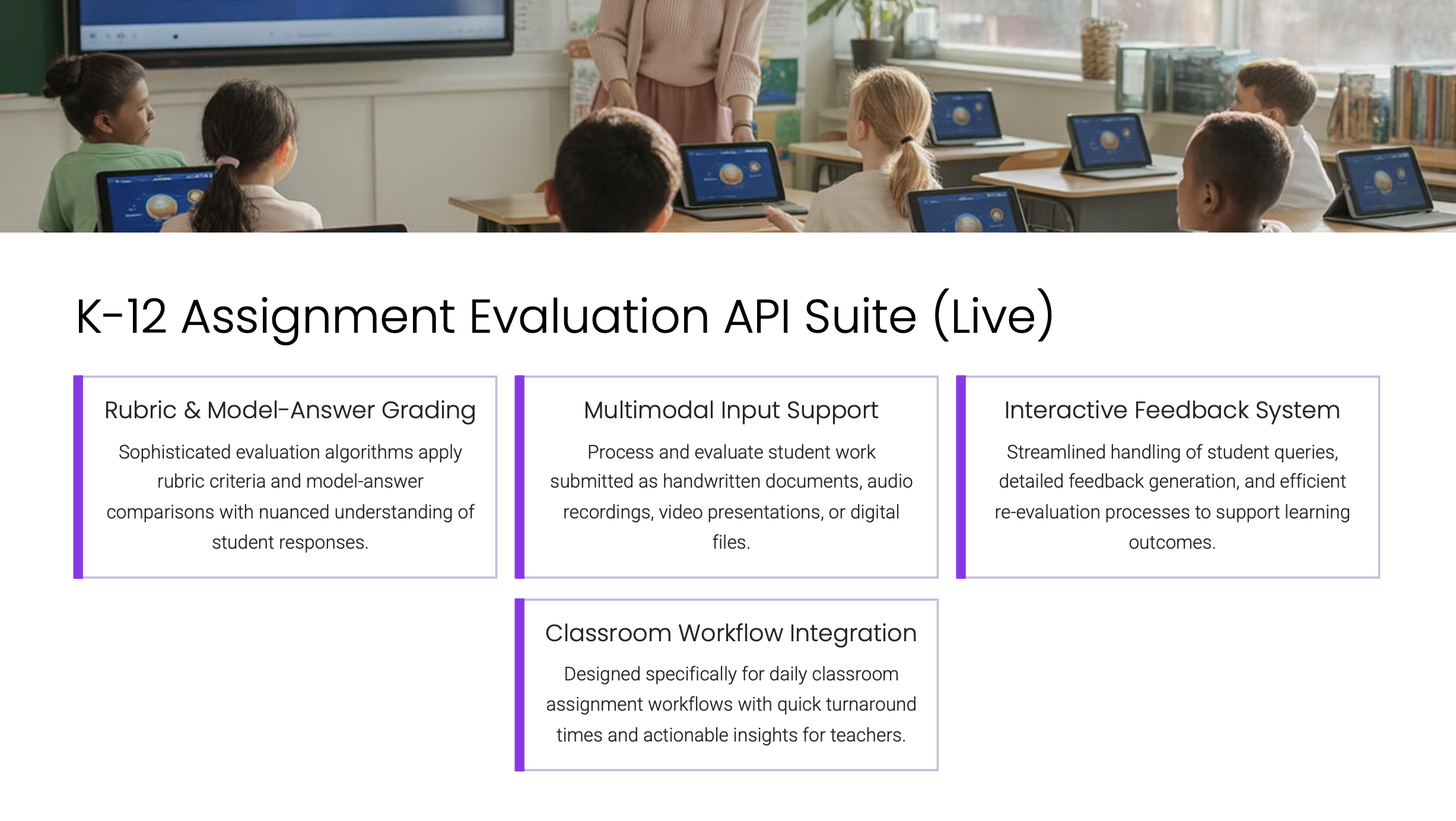
* **Rubric + Model-Answer Grading**\
Apply detailed rubric criteria or model-answer comparisons to evaluate assignments fairly.
* **Multi-modal Input Support**\
Evaluate **handwritten submissions, typed documents, and video presentations**.
* **Interactive Feedback System**\
Generate detailed feedback, handle student queries, and enable re-evaluations to support learning.
* **Classroom Workflow Integration**\
Designed for **daily assignments with quick turnaround**, helping teachers respond rapidly.
* **Transparent & Auditable**\
Track evaluation history with re-checks, audit trails, and compliance-ready documentation.
## Supported Modalities
* ✅ Handwritten documents (PDF/images)
* ✅ Typed/digital text responses
* ✅ Diagrams and visuals
* ✅ Video presentations
 ***
## Stakeholder Value
* **Students** → Receive fast, detailed feedback on daily work.
* **Teachers** → Save hours weekly, with insights into class-wide misconceptions.
* **Leaders** → Monitor assignment completion, feedback cycles, and learning trends.
* **Parents** → Get simple summaries of assignment performance to support learning at home.
***
## Developer & UI Options
* **REST/JSON API** for backend integration into LMS/ERP.
* **Embeddable UI modules** to plug assignment workflows directly into platforms without heavy dev effort.
***
## Ecosystem Integration
* **Upstream**: Assignment submission uploads (handwritten, digital, audio, video).
* **Downstream**: Results flow into the **Personalization Suite** (reteach strategies, practice packs), then into **AI Studio** for worksheet and remedial content generation.
* **Continuous Loop**: Observation signals from ClassTrack refine future assignments.
***
## Next Steps
* Learn the step-by-step process in the [Workflow guide](/products/assignment/workflow).
* Explore practical [Use Cases](/products/assignment/usecase) for Schools, Tutoring, LMS/ERP, and E-learning.
* API Reference: [Assignments](/api-reference/endpoint/assignments/v1-assignment) · [Assignment Student Answer](/api-reference/endpoint/assignments/v1-assignment-student-answer) · [Assignment Student Answer by ID](/api-reference/endpoint/assignments/v1-assignment-student-answer-id) · [Rubrics](/api-reference/endpoint/rubrics/v1-rubric-list) · [Constants](/api-reference/endpoint/assignments/v1-constants) · [Webhooks](/api-reference/endpoint/webhook/v1-get-webhook-template).
## FAQ
Assignment evaluates typed documents, scanned handwriting, diagrams, audio, and video. It applies rubric or model‑answer logic and returns structured artifacts—scores, feedback JSON, and annotated copies—optimized for classroom and LMS/ERP workflows. These outputs are designed to be explainable, auditable, and immediately usable downstream.
Submissions are mapped to configurable rubrics or model answers so the same criteria apply across modalities. The system produces rubric‑aware scores and explanations, along with annotated copies for transparency. Educators can calibrate rubrics to board standards and refine over time without ML expertise.
Teachers and reviewers can approve, edit, or recheck results before publishing, preserving educator control on subjective items. Every action is tracked with audit logs and step‑wise marking, and you can use provisional/final publication states. This workflow keeps quality high while maintaining operational speed.
Assignment targets up to 95% accuracy using rubric‑aware scoring and cross‑checks, then adds a human‑in‑the‑loop review for nuanced responses. Edge cases can be flagged for quick validation or re‑evaluation, with versioned changes captured in audit trails. This balance delivers reliable outcomes without losing teacher judgment.
Evaluation outputs—scores, feedback JSON, and annotated copies—flow directly into Student Action Plans to group misconceptions and recommend reteach strategies. The same insights power AI Studio to generate curriculum‑aligned lesson plans, worksheets, and model answers. This closes the loop from evaluate → personalize → generate with minimal manual effort.
You can launch fast with a white‑label, embeddable UI or integrate via REST/JSON APIs for deeper control. Typical integrations are designed for 24h integration and require no AI team, while preserving full branding and UX consistency. Both paths deliver the same pipeline and artifacts (scores, feedback JSON, annotated copies).
Yes. Assignment ingests scanned exam sheets (images/PDFs) and diagrams alongside typed responses, handwriting, audio, and video. All are evaluated against rubric or model‑answer logic so results remain consistent across formats.
Workflows, reports, and generated materials are CBSE/ICSE/GDPR aligned, with export‑ready reports and audit trails for inspections. Configurable retention and mappings help you fit board standards while maintaining privacy‑by‑design practices. This ensures grading and publication stay compliant across boards and regions.
Rubrics and model answers are configurable to match CBSE/ICSE mappings and local standards, and can be tuned per subject or grade. Reviewers can enforce provisional/final publication states and recheck policies within the human‑in‑the‑loop flow. These controls keep outcomes consistent and governance‑ready at scale.
Assignment supports role‑based access, audit logs, and exportable reports to standardize governance. Results can be published to your LMS/ERP, and downstream workflows (Action Plans, AI Studio) stay aligned with board policies. This makes large deployments transparent, auditable, and easy to operate without a dedicated AI team.
***
## Stakeholder Value
* **Students** → Receive fast, detailed feedback on daily work.
* **Teachers** → Save hours weekly, with insights into class-wide misconceptions.
* **Leaders** → Monitor assignment completion, feedback cycles, and learning trends.
* **Parents** → Get simple summaries of assignment performance to support learning at home.
***
## Developer & UI Options
* **REST/JSON API** for backend integration into LMS/ERP.
* **Embeddable UI modules** to plug assignment workflows directly into platforms without heavy dev effort.
***
## Ecosystem Integration
* **Upstream**: Assignment submission uploads (handwritten, digital, audio, video).
* **Downstream**: Results flow into the **Personalization Suite** (reteach strategies, practice packs), then into **AI Studio** for worksheet and remedial content generation.
* **Continuous Loop**: Observation signals from ClassTrack refine future assignments.
***
## Next Steps
* Learn the step-by-step process in the [Workflow guide](/products/assignment/workflow).
* Explore practical [Use Cases](/products/assignment/usecase) for Schools, Tutoring, LMS/ERP, and E-learning.
* API Reference: [Assignments](/api-reference/endpoint/assignments/v1-assignment) · [Assignment Student Answer](/api-reference/endpoint/assignments/v1-assignment-student-answer) · [Assignment Student Answer by ID](/api-reference/endpoint/assignments/v1-assignment-student-answer-id) · [Rubrics](/api-reference/endpoint/rubrics/v1-rubric-list) · [Constants](/api-reference/endpoint/assignments/v1-constants) · [Webhooks](/api-reference/endpoint/webhook/v1-get-webhook-template).
## FAQ
Assignment evaluates typed documents, scanned handwriting, diagrams, audio, and video. It applies rubric or model‑answer logic and returns structured artifacts—scores, feedback JSON, and annotated copies—optimized for classroom and LMS/ERP workflows. These outputs are designed to be explainable, auditable, and immediately usable downstream.
Submissions are mapped to configurable rubrics or model answers so the same criteria apply across modalities. The system produces rubric‑aware scores and explanations, along with annotated copies for transparency. Educators can calibrate rubrics to board standards and refine over time without ML expertise.
Teachers and reviewers can approve, edit, or recheck results before publishing, preserving educator control on subjective items. Every action is tracked with audit logs and step‑wise marking, and you can use provisional/final publication states. This workflow keeps quality high while maintaining operational speed.
Assignment targets up to 95% accuracy using rubric‑aware scoring and cross‑checks, then adds a human‑in‑the‑loop review for nuanced responses. Edge cases can be flagged for quick validation or re‑evaluation, with versioned changes captured in audit trails. This balance delivers reliable outcomes without losing teacher judgment.
Evaluation outputs—scores, feedback JSON, and annotated copies—flow directly into Student Action Plans to group misconceptions and recommend reteach strategies. The same insights power AI Studio to generate curriculum‑aligned lesson plans, worksheets, and model answers. This closes the loop from evaluate → personalize → generate with minimal manual effort.
You can launch fast with a white‑label, embeddable UI or integrate via REST/JSON APIs for deeper control. Typical integrations are designed for 24h integration and require no AI team, while preserving full branding and UX consistency. Both paths deliver the same pipeline and artifacts (scores, feedback JSON, annotated copies).
Yes. Assignment ingests scanned exam sheets (images/PDFs) and diagrams alongside typed responses, handwriting, audio, and video. All are evaluated against rubric or model‑answer logic so results remain consistent across formats.
Workflows, reports, and generated materials are CBSE/ICSE/GDPR aligned, with export‑ready reports and audit trails for inspections. Configurable retention and mappings help you fit board standards while maintaining privacy‑by‑design practices. This ensures grading and publication stay compliant across boards and regions.
Rubrics and model answers are configurable to match CBSE/ICSE mappings and local standards, and can be tuned per subject or grade. Reviewers can enforce provisional/final publication states and recheck policies within the human‑in‑the‑loop flow. These controls keep outcomes consistent and governance‑ready at scale.
Assignment supports role‑based access, audit logs, and exportable reports to standardize governance. Results can be published to your LMS/ERP, and downstream workflows (Action Plans, AI Studio) stay aligned with board policies. This makes large deployments transparent, auditable, and easy to operate without a dedicated AI team.