> ## Documentation Index
> Fetch the complete documentation index at: https://docs.crazygoldfish.com/llms.txt
> Use this file to discover all available pages before exploring further.
# Action Plan Overview
> Turn evaluation results into personalized action plans for students, teachers, and parents — bridging assessment and remediation.
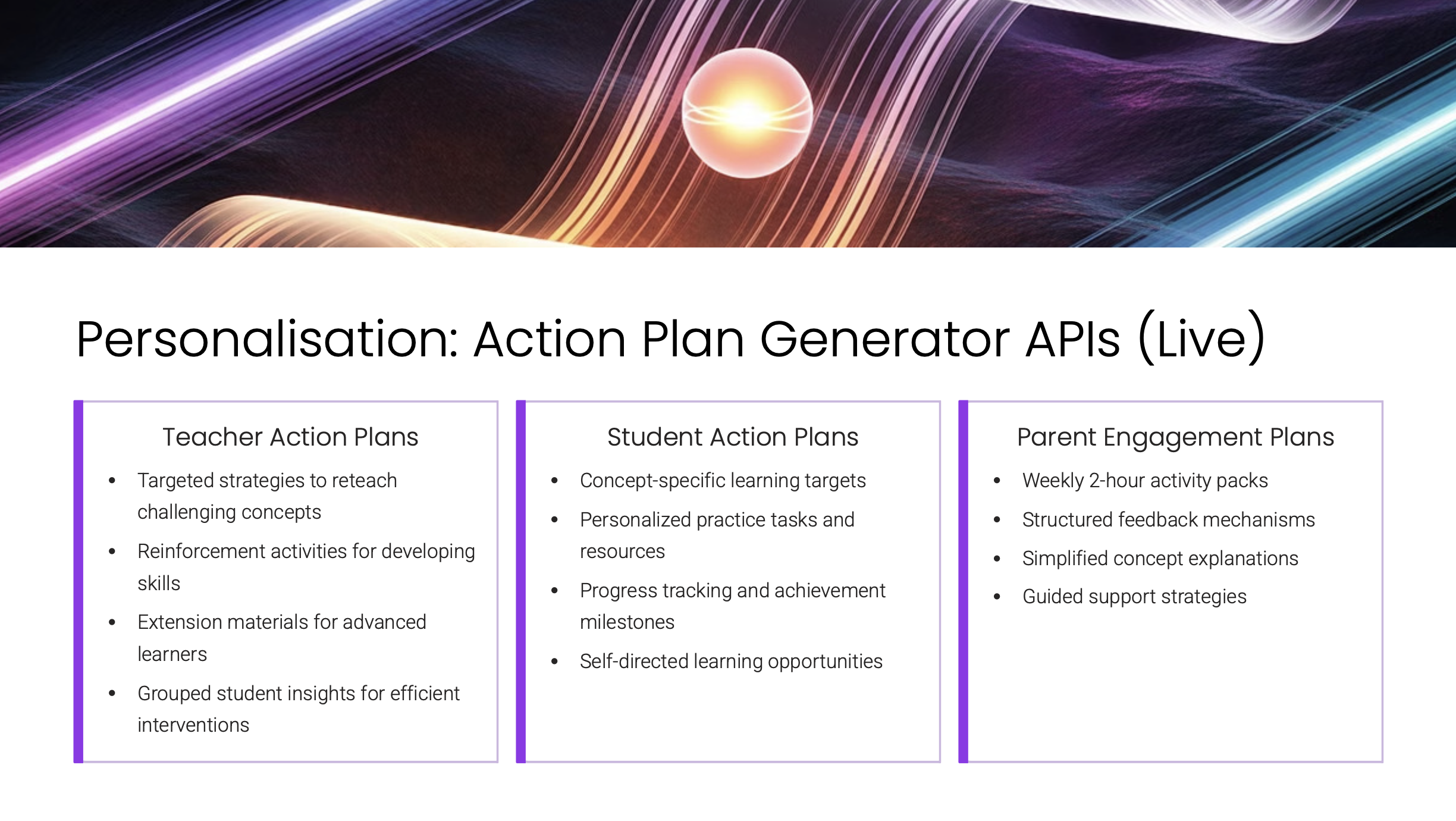
The **Personalization Layer** transforms evaluation results into **actionable strategies**. The Action Plan APIs generate **student targets, teacher reteach guides, and parent activity packs**, ensuring that assessment data drives measurable improvement across the ecosystem.
***
## Why Personalization Matters
* **Problem:** Evaluation without remediation leaves learning gaps unresolved.
* **Solution:** Action Plan APIs close the loop by converting scores + feedback into **personalized action plans** for every stakeholder.
* **Ecosystem Fit:** Plans flow downstream into **AI Studio** (auto-generate lesson plans, worksheets, and remedial content) and are refined upstream by **ClassTrack** observations.
***
## Three APIs, One Purpose
Learning targets, personalized practice, and progress milestones.
Group insights, reteach strategies, and extension content.
Weekly activity packs, simplified guides, and structured home support.
 ***
## Ecosystem Integration
* **Upstream:** Inputs from **Exam & Assignment Evaluation Suites** (scores, feedback, annotated copies).
* **Core:** Action Plan APIs → generate tailored strategies for students, teachers, and parents.
* **Downstream:** Output feeds into **AI Studio** for content generation and **ClassTrack** for continuous improvement.
***
## Next Steps
* Start with [Student Action Plan](/products/student-action-plan/features).
* Or explore [Teacher](/products/teacher-action-plan/features) and [Parent](/products/parent-action-plan/features) plans directly.
* API Reference: [Student Action Plan POST](/api-reference/endpoint/action-plans/k12-v1-student-action-plan-post) · [Teacher Action Plan POST](/api-reference/endpoint/action-plans/k12-v1-teacher-action-plan-post) · [Webhooks](/api-reference/endpoint/webhook/v1-get-webhook-template).
## FAQ
CrazyGoldFish connects Evaluate → Personalize → Generate → Observe → Engage so criteria-level scores, strengths, and improvement areas flow directly into actionable plans. Student targets, teacher reteach strategies, and parent-friendly updates are generated from the same evidence, keeping outcomes CBSE/ICSE/GDPR aligned and auditable. A human-in-the-loop workflow ensures educators can review or adjust before publishing.
It consumes multimodal evaluation artifacts—text, handwriting, diagrams, audio, and video—scored via rubric and/or model-answer logic with strengths and improvement suggestions. Delivery is API-first (REST and webhooks) with structured JSON plus exportable PDFs/CSVs for LMS/ERP updates; most teams complete a 24h integration with no AI team required.
Evaluation outputs power Teacher Action Plans that cluster common errors and misconceptions for targeted reteach groups. These insights publish alongside criteria-level feedback and can be exported to your LMS/ERP, giving educators a practical, standards-aligned starting point for instruction.
Teachers remain in control—review, calibrate, or override evaluations before plans are published, with audit logs for every change. This preserves trust, keeps workflows CBSE/ICSE/GDPR aligned, and ensures personalized recommendations reflect institution-approved outcomes.
Yes. You can launch a white-label embeddable UI for ultra-fast rollout or stitch the APIs into existing flows to push results and plans to your LMS/ERP. Exports (PDF/CSV), role-based access, and branding controls let you keep your UX while adopting the Evaluate → Personalize pipeline in 24h—no AI team required.
Because the upstream Evaluation Layer is multimodal, the Personalization Layer uses consistent, rubric/model‑answer–aligned evidence from text, handwriting, diagrams, audio, and video. This keeps plans coherent across formats and aligned to board expectations with transparent artifacts for audits.
Workflows are CBSE/ICSE/GDPR aligned with privacy-by-design, audit logs, and export controls. Plans and reports remain traceable and inspection-ready, and data handling can be mapped to institutional policies (e.g., role-based access and retention) without bespoke ML operations.
Once plans are created, AI Studio generates standards-aligned lesson plans, worksheets, exams, and model answers tied to the identified gaps. Educators stay in the loop to accept or edit materials, closing the Evaluate → Personalize → Generate loop for fast, accountable remediation.
Students or staff can trigger rechecks that append audit logs and update outcomes after human review. The Personalization Layer then refreshes action plans and exports so downstream LMS/ERP reports and artifacts stay consistent and transparent.
Start with the embeddable, white-label UI and sandbox keys to stand up a pilot in 24h, then wire REST APIs and webhooks for deeper orchestration. As you promote to production, connect exports to your LMS/ERP and enable human-in-the-loop checkpoints to maintain up to 95% accuracy while scaling—no AI team required.
***
## Ecosystem Integration
* **Upstream:** Inputs from **Exam & Assignment Evaluation Suites** (scores, feedback, annotated copies).
* **Core:** Action Plan APIs → generate tailored strategies for students, teachers, and parents.
* **Downstream:** Output feeds into **AI Studio** for content generation and **ClassTrack** for continuous improvement.
***
## Next Steps
* Start with [Student Action Plan](/products/student-action-plan/features).
* Or explore [Teacher](/products/teacher-action-plan/features) and [Parent](/products/parent-action-plan/features) plans directly.
* API Reference: [Student Action Plan POST](/api-reference/endpoint/action-plans/k12-v1-student-action-plan-post) · [Teacher Action Plan POST](/api-reference/endpoint/action-plans/k12-v1-teacher-action-plan-post) · [Webhooks](/api-reference/endpoint/webhook/v1-get-webhook-template).
## FAQ
CrazyGoldFish connects Evaluate → Personalize → Generate → Observe → Engage so criteria-level scores, strengths, and improvement areas flow directly into actionable plans. Student targets, teacher reteach strategies, and parent-friendly updates are generated from the same evidence, keeping outcomes CBSE/ICSE/GDPR aligned and auditable. A human-in-the-loop workflow ensures educators can review or adjust before publishing.
It consumes multimodal evaluation artifacts—text, handwriting, diagrams, audio, and video—scored via rubric and/or model-answer logic with strengths and improvement suggestions. Delivery is API-first (REST and webhooks) with structured JSON plus exportable PDFs/CSVs for LMS/ERP updates; most teams complete a 24h integration with no AI team required.
Evaluation outputs power Teacher Action Plans that cluster common errors and misconceptions for targeted reteach groups. These insights publish alongside criteria-level feedback and can be exported to your LMS/ERP, giving educators a practical, standards-aligned starting point for instruction.
Teachers remain in control—review, calibrate, or override evaluations before plans are published, with audit logs for every change. This preserves trust, keeps workflows CBSE/ICSE/GDPR aligned, and ensures personalized recommendations reflect institution-approved outcomes.
Yes. You can launch a white-label embeddable UI for ultra-fast rollout or stitch the APIs into existing flows to push results and plans to your LMS/ERP. Exports (PDF/CSV), role-based access, and branding controls let you keep your UX while adopting the Evaluate → Personalize pipeline in 24h—no AI team required.
Because the upstream Evaluation Layer is multimodal, the Personalization Layer uses consistent, rubric/model‑answer–aligned evidence from text, handwriting, diagrams, audio, and video. This keeps plans coherent across formats and aligned to board expectations with transparent artifacts for audits.
Workflows are CBSE/ICSE/GDPR aligned with privacy-by-design, audit logs, and export controls. Plans and reports remain traceable and inspection-ready, and data handling can be mapped to institutional policies (e.g., role-based access and retention) without bespoke ML operations.
Once plans are created, AI Studio generates standards-aligned lesson plans, worksheets, exams, and model answers tied to the identified gaps. Educators stay in the loop to accept or edit materials, closing the Evaluate → Personalize → Generate loop for fast, accountable remediation.
Students or staff can trigger rechecks that append audit logs and update outcomes after human review. The Personalization Layer then refreshes action plans and exports so downstream LMS/ERP reports and artifacts stay consistent and transparent.
Start with the embeddable, white-label UI and sandbox keys to stand up a pilot in 24h, then wire REST APIs and webhooks for deeper orchestration. As you promote to production, connect exports to your LMS/ERP and enable human-in-the-loop checkpoints to maintain up to 95% accuracy while scaling—no AI team required.